 Ultimate guide
Are Domestic Cleaners Insured? A Homeowner's Guide
Last Updated: November 19, 2026
Quick Summary
No law requires domestic cleaners to hold insurance, so are domestic cleaners insured in the UK depends entirely on who you hire. A self-employed cleaner may carry public liability cover or may not, while an agency or company should hold it but you need to see the certificate rather than take a claim at face value.
- Public liability insurance covers injury to third parties and damage to their property while the cleaner is working.
- Employers' liability insurance is legally required for most businesses that employ staff, but not for households hiring directly.
- Ask for the certificate of insurance and check the policyholder name matches the business you are hiring.
- Ring the insurer on the number printed on the certificate to confirm the policy is active today.
- Standard home contents policies usually do not cover a domestic cleaner in the way people hope.
Table of Contents
- Are Domestic Cleaners Insured? The Straight Answer
- Public Liability Insurance for Cleaners and What It Covers
- Hiring a Self-Employed Cleaner vs Agency: Who Carries the Risk
- Employers' Liability Insurance and When It Is a Legal Requirement
- How to Verify Cleaner Insurance Before the First Visit
- Policy Exclusions and Limits in Plain English
- What Happens After an Accident or Damage Claim
- Types of Cleaning Work Covered and the Cover Options to Compare
- Does Home Insurance Cover a Domestic Cleaner?
- Book a Cleaner Whose Cover You Can Check Before You Book
- Frequently Asked Questions
Are Domestic Cleaners Insured? The Straight Answer
The short answer to whether domestic cleaners are insured in the UK is that no law requires a domestic cleaner to hold insurance, so whether your cleaner is covered depends entirely on who you hire. Many households assume a cleaner arrives insured. Often they do not.
Public liability insurance is cover that pays for injury to other people or damage to their property caused by the policyholder's work. It is the policy that matters most in a domestic setting.
A self-employed cleaner may carry it, may not, and is under no statutory duty to do so. An agency or company should carry it, but you need to see the certificate rather than take a claim at face value. Below, we break down what each type of cover does, who carries the risk in each hiring arrangement, and how to check a policy before anyone touches your kitchen.
Public Liability Insurance for Cleaners and What It Covers
Public liability insurance for cleaners covers two things: injury to a third party and damage to their property while the cleaner is working. It is not a legal requirement for domestic work, but it is the policy that decides whether an accident costs you or the person holding the cloth.
What most guides miss is that the policy protects the cleaner from claims, not you from inconvenience. If your cleaner has no cover and smashes a worktop, your only route is to ask them to pay, or to claim on your own home insurance and accept the consequences for your premium.
Accidental Damage to a Client's Property
Accidental damage cover pays out when a cleaner knocks over a vase, scratches a floor or damages an appliance. The policy responds to the claim, subject to the excess and the limit. Without it, the cleaner pays from their own pocket, or the householder absorbs the loss.
Injury to a Client or Other Third Party
Third-party injury cover responds if someone is hurt because of the cleaning work, for example a client slipping on a wet floor the cleaner failed to sign. Cover limits vary widely, and lower limits can be exhausted quickly where medical costs or loss of earnings are involved.
Hiring a Self-Employed Cleaner vs Agency: Who Carries the Risk
Risk sits with whoever employs the cleaner, and that distinction matters more than most people realise. A genuinely self-employed cleaner carries their own insurance, pays their own tax and controls how the work is done. An agency or company employs its staff, so the business carries the liability and should hold the cover.
The line blurs when a household dictates hours, supplies all equipment and supervises closely. In that scenario, a cleaner labelled self-employed may in practice be an employee, which shifts duties onto the household. If you are weighing up how to pay your cleaner fairly alongside these arrangements, our guidance on whether to tip your house cleaner covers the practical side.
Employers' Liability Insurance and When It Is a Legal Requirement
Employers' liability insurance is legally required for most businesses that employ staff, and it covers claims from employees who are injured or fall ill because of their work. The requirement comes from the Employers' Liability (Compulsory Insurance) Act 1969, enforced by the Health and Safety Executive.
A business with employees must hold employers' liability cover, and must be able to show a certificate. Sole traders with no employees are outside the requirement. A household hiring a cleaner directly is not running a business, so the duty does not apply, but that does not mean the household has no exposure.
Who Is Responsible When a Cleaner Is Employed Directly by a Household
When a household employs a cleaner directly, the household becomes the employer for practical purposes. That brings duties around safe working conditions and, in some circumstances, vicarious liability for the cleaner's actions. Your home insurer may not step in. This is the arrangement people underestimate most.
How to Verify Cleaner Insurance Before the First Visit
Verification takes about five minutes and saves months of argument. The aim is not to collect a piece of paper but to confirm three things: that a policy exists, that it is current, and that it covers the work being done in your home. Most people stop at the first and assume the rest.
Ask for the certificate of insurance. It should be a PDF or printed document from the insurer, not a screenshot of a quote or a badge on a website. Check the policyholder name matches the business you are hiring, a certificate in a different name may mean the policy belongs to someone else or has lapsed. Confirm the policy is in date today, not just on the date the certificate was issued. Read the public liability limit and the excess, and note whether the policy covers domestic cleaning specifically.
Then ring the insurer on the number printed on the certificate, not the number the cleaner gives you. Ask two questions: is the policy active today, and does it cover residential cleaning work at a client's home? Some insurers will confirm active policies to third parties, while others will only confirm to the policyholder. If the insurer will not speak to you, ask the cleaner to request a letter of confirmation directly from the insurer and send it to you.
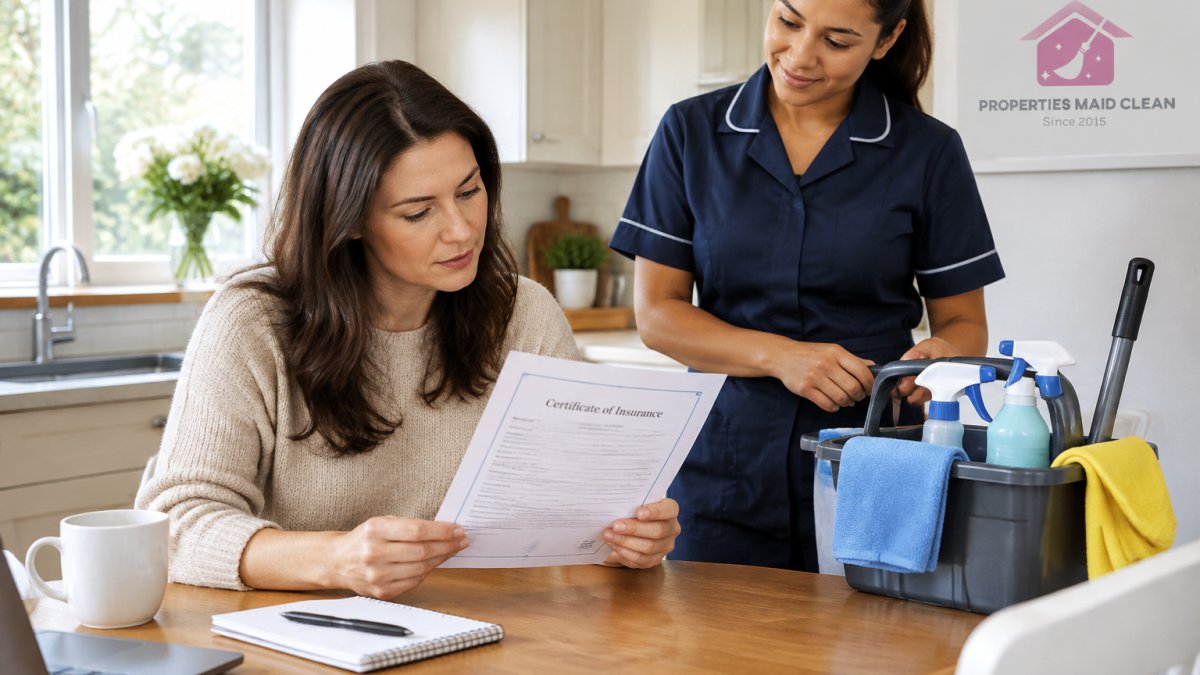
Watch out: a certificate proves a policy existed on the date printed, not that it covers domestic cleaning work or that it is still in force. A common pattern is a cleaner who holds a policy for commercial office cleaning but has not declared residential work, which can leave a claim unpaid.
- Policyholder name matches the trading name
- Policy is in date today
- Public liability limit stated
- Excess stated
- Domestic cleaning confirmed as covered work
- Insurer confirms cover by phone
If the cleaner is self-employed and cannot produce a certificate, ask whether they hold cover at all. Some do not, and that is a commercial decision for you. If they are supplied by an agency, the agency should hold the policy and you should ask for the certificate in the agency's name. Do not accept a verbal assurance that "we are fully insured" without seeing the document.
If you would rather not chase paperwork, you can contact the team and ask for proof of cover before anything is booked.
Policy Exclusions and Limits in Plain English
Exclusions are where claims die. A policy may exclude damage to property in your care, custody or control, which is precisely what cleaning involves, because the cleaner is handling your possessions. Others exclude work at height, use of certain chemicals, or damage caused by a subcontractor the cleaner brought along without declaring them. Some exclude damage to keys, or theft by the cleaner, which is a separate cover altogether.
Limits work the same way. A policy limit can sound generous until a claim involves significant property damage and lost income. The limit is the most the insurer will pay in total for any one claim, and it may be reduced by costs and expenses. The excess is the first slice of any claim you or the cleaner pays, and its amount varies by policy. If the excess is £250 and the damage is £200, the insurer pays nothing.
Conditions matter as much as exclusions. A policy may require the cleaner to report incidents within a set period, keep certain records, or not admit liability at the scene. Breach a condition and the insurer can decline the claim even where the damage is otherwise covered. Read the policy wording, not the summary, and ask the insurer to confirm the exclusions and conditions in writing before you rely on them.
Watch out: a common pattern is a cleaner who holds public liability cover but has not declared that they use a steam cleaner or work at height on windows, which can leave a claim unpaid even though the policy is active.
What Happens After an Accident or Damage Claim
Report the damage to the cleaner or company the same day, photograph everything, and keep any damaged item until the claim is settled. The cleaner notifies their insurer, the insurer assesses, and the excess is deducted from the payout. Timelines vary by insurer.
If the cleaner is uninsured, the conversation becomes personal. You can ask them to cover the repair, claim on your own home insurance, or pursue the matter through the courts. Each option has a cost, and the cheapest is usually the one you planned for before the visit.
Types of Cleaning Work Covered and the Cover Options to Compare
Standard domestic cleaning is generally straightforward to insure. Deep cleans and other specialised work may need to be declared to the insurer.
| Cover type | What it protects | Legal requirement | Who needs it |
|---|---|---|---|
| Public liability | Clients, third parties, their property | No | Self-employed cleaners, agencies |
| Employers' liability | Employees injured at work | Yes, for most employers | Companies with staff |
| Occupiers' liability | Visitors to premises | No | Anyone controlling premises |
| Home insurance (householder's) | Your own home and contents | No | Householders |
If you are weighing a one-off deep clean against regular visits, pricing depends on the scope of the work, so get a quote for current prices.
Does Home Insurance Cover a Domestic Cleaner?
Usually not in the way people hope. Standard home contents policies cover your possessions against defined events, and some extend to accidental damage caused by domestic staff. Check your policy wording before you rely on it.
The safer position, when asking are domestic cleaners insured in the UK, is to hire someone who holds their own public liability cover and can prove it. That way the claim goes to their insurer first, and your policy stays untouched.
Book a Cleaner Whose Cover You Can Check Before You Book
The challenge is not finding a cleaner. It is finding one whose insurance you can verify before the first visit, and who turns up as the same person each week rather than a rotating stranger.
That is what we built Properties Maid Clean Ltd around. Every client gets a personally allocated cleaner, so you know who is in your home. Our Client Hub lets you manage bookings and invoices in one place. We won the 2025 Best Cleaning Company Quality Award.
You can see the cleaning services on offer and check cover before committing, or follow our step-by-step guide to booking a weekly cleaner if you are ready to arrange regular visits.
Get started with Properties Maid Clean Ltd and book a cleaner whose insurance you have seen for yourself.
Insurance is not the most exciting part of hiring a cleaner, but it is the part that decides who pays when something breaks. Ask for the certificate, ring the insurer, and read the exclusions before the first visit rather than after the first accident.
Frequently Asked Questions
Are self-employed cleaners required to have insurance?
There is no blanket legal requirement for a self-employed domestic cleaner to hold insurance, unless they employ others or the client's contract demands it. Public liability cover is optional but strongly advised, because an accidental damage claim in a client's home can be costly. If a self-employed cleaner employs staff, employers' liability insurance becomes a legal requirement. Always ask for a certificate before the first visit.
What happens if a cleaner breaks something in my home?
If the cleaner holds public liability insurance, they report the damage to their insurer, who assesses the claim against the policy limit and any excess. You should photograph the damage, keep the broken item, and put the claim in writing. If the cleaner is uninsured, your only route is to ask them to pay directly or pursue them through the courts. Check policy wording and exclusions before work starts so you know where you stand.
Does my home insurance cover a domestic cleaner?
Standard home contents policies sometimes extend to accidental damage caused by domestic staff, but the cover is often limited, excludes business use, and may only apply to employed staff rather than independent contractors. Check your policy wording or ring your insurer before relying on it. Even where cover exists, claiming may affect your no-claims discount, so a cleaner with their own public liability policy is usually the tidier arrangement.
How do I check if my cleaner is insured?
Ask for a certificate of insurance and check the policyholder name matches the person or company you are hiring, the cover type includes public liability, the policy is current, and the limit is realistic. Ring the insurer on the number on the certificate to confirm it is live. For a company, ask whether the cleaner arriving is an employee or a subcontractor, because cover does not always follow subcontractors.
Is it safer to hire a cleaning agency or an independent cleaner?
An agency usually carries public liability and employers' liability cover for its staff, which removes most of the risk from you. An independent cleaner may hold their own policy, but you must verify it. The trade-off is cost and control: agencies typically cost more but handle insurance, vetting and cover for absences. Independent cleaners can be cheaper and more flexible, but the insurance checks sit with you.
What is public liability insurance for cleaners?
It covers claims from third parties for injury or property damage arising from the cleaning work. For a domestic cleaner, that means accidental damage to a client's home, such as a broken ornament or scratched floor, and injury to a client or visitor. It does not cover the cleaner's own injury or their equipment, which need separate cover. Policy limits vary, so compare the limit and excess, not just the premium.